Chapter 2: The AI Toolbox for Facilities Management
AI in Facilities Management is not a monolithic product or a generic chatbot; it is an integrated toolbox of six specialized algorithmic capabilities. When orchestrated together, they transform static physical infrastructure into an intelligent, self-monitoring, and revenue-accretive operational asset.
2.1 The Industry-Verified AI Impact Ceilings
Independent global benchmarks across millions of square meters of commercial, healthcare, and industrial portfolios confirm substantial operational improvements when combining multiple AI disciplines:
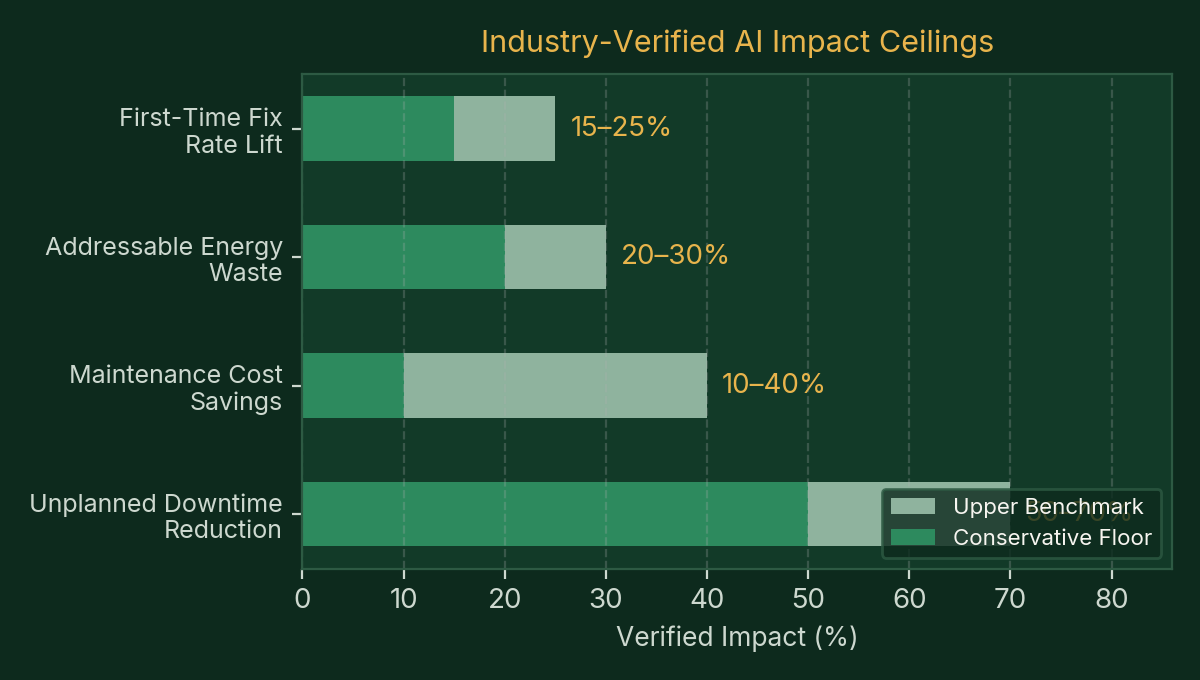
- Unplanned Equipment Downtime: Reduced by 50% to 70% via vibration, thermal, and electrical telemetry forecasting.
- Preventive Maintenance Labor Cost: Reduced by 10% to 40% by replacing rigid calendar cycles with true condition-based triggers.
- Commercial Energy Consumption: Curtailed by 15% to 30% through autonomous chiller plant and AHU optimization.
- Helpdesk & Dispatch Overhead: Lowered by 30% via agentic automated triaging.
2.2 The 6 Specialized AI Capabilities
graph TD
    subgraph Perception
        V[1. Vision AI & Multimodal<br/>CCTV leak, PPE & occupancy]
        M[2. Multimodal Mobile Copilot<br/>Voice-to-order & O&M retrieval]
    end
    subgraph Intelligence
        P[3. Predictive Analytics<br/>RUL modeling & fault detection]
        O[4. Optimization & RL<br/>HVAC setpoints & routing]
    end
    subgraph Execution
        G[5. Generative AI<br/>RFP costing & client dossiers]
        A[6. Agentic Orchestration<br/>BMS ↔ CAFM ↔ ERP sync]
    end
    Perception --> Intelligence --> Execution
1. Vision AI: Turning Existing CCTV into a 24/7 Digital Sentinel
Traditional facility camera systems are passive security recording devices that only get reviewed after an incident occurs. Vision AI converts existing IP cameras and CCTV feeds into active, real-time diagnostic sensors without installing new wiring or intrusive sensors.
[ Physical World ]
       │
       ▼  CCTV Camera Stream (RTSP / ONVIF)
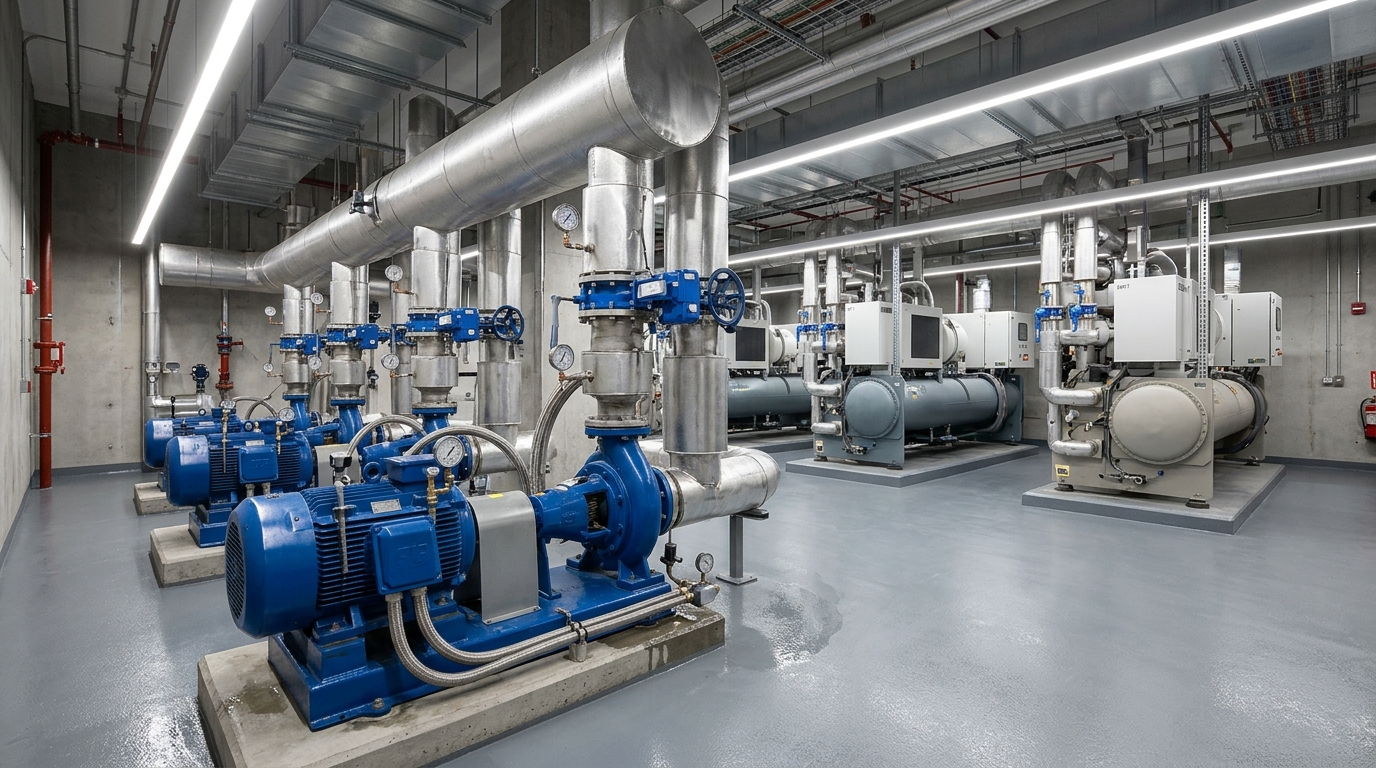
[ Vision AI Model ] ──► Detects abnormal water pooling near Chilled Water Pump P-03
       │
       ▼  Contextual Geometry Engine
[ Context Engine ] ──► Correlates asset ID, confirms no personnel present, flags rising severity
       │
       ▼  Automated Action
[ Actionable Alert ] ─► Generates CAFM work order: "Chilled water leak detected at P-03 mechanical seal"
- Mechanical Leak Detection: Identifies subtle water accumulation, oil pooling, and refrigerant line condensation in unstaffed plant rooms.
- HSEQ & Safety Compliance: Continuously flags missing personal protective equipment (PPE)—hard hats, high-vis vests, safety goggles—in mechanical basements and high-voltage switchgear rooms.
- Space & Occupancy Optimization: Measures real-time footfall, desk utilization, and queue density to trigger dynamic on-demand cleaning rather than scheduled sweeps.
[!TIP] Monetisation & Authority Tip:
Do not spend capital on thousands of new standalone IoT sensors. Leverage your client's existing security CCTV infrastructure by overlaying lightweight Vision AI edge inference models.
2. Agentic AI: Autonomous Cross-System Orchestration
The ultimate operational bottleneck in modern FM is human triage latency. A BMS detects a temperature threshold breach; a human operator must notice the alarm, open the CAFM software, manually draft a work order, verify parts availability in SAP/Oracle ERP, and call a technician.

Agentic AI acts as an autonomous operational conductor, operating seamlessly across legacy system boundaries:
- Cross-System Synchronization: Continuously reads telemetry from BMS/SCADA, validates asset status against CAFM history, and verifies spare parts inventory in ERP.
- Coordinated Multi-Service Dispatch: When a pump seal fails, the agentic engine automatically:
- Isolates the pump sequence via BMS logic.
- Dispatches a certified mechanical technician with the exact replacement seal model and torque specifications.
- Dispatches a cleaning team to remediate pooled water before it breaches electrical conduits.
- Human-in-the-Loop Safeguards: High-risk actions (HVAC total shutdowns, fire suppression overrides, high-value procurement) automatically halt and require supervisor tap-to-approve confirmation on a mobile terminal.
3. Predictive Machine Learning: Remaining Useful Life (RUL)
Predictive models ingest high-frequency sensor telemetry—compressor discharge temperatures, motor vibration spectra, motor stator current, and differential pressure—to forecast mechanical degradation:
$$\text{RUL} = f(\text{Vibration Amplitude}, \Delta T_{\text{lift}}, \Delta P_{\text{refrigerant}}, \text{Runtime Hours})$$
- Shifts maintenance from reactive firefighting (repairing after catastrophic breakdown) and inflexible preventive PPM (servicing machines that do not need it) to prescriptive maintenance (servicing assets exactly when required before performance degrades).
- Generates 15- to 30-day early failure warnings, converting high-stress emergency repairs into orderly, scheduled off-peak overhauls.
4. Multimodal Mobile Copilots: Empowering Field Technicians
Frontline technicians often waste up to 40% of their billable shift traveling back to the site office, searching through dusty paper O&M manuals, and typing tedious work order summaries on cramped mobile keyboards.
- Voice-to-Work-Order Logging: Technicians speak natural language audio notes in English, Arabic, or Hindi. The multimodal copilot transcribes, extracts technical parameters, structures the summary, and closes the CAFM job card automatically.
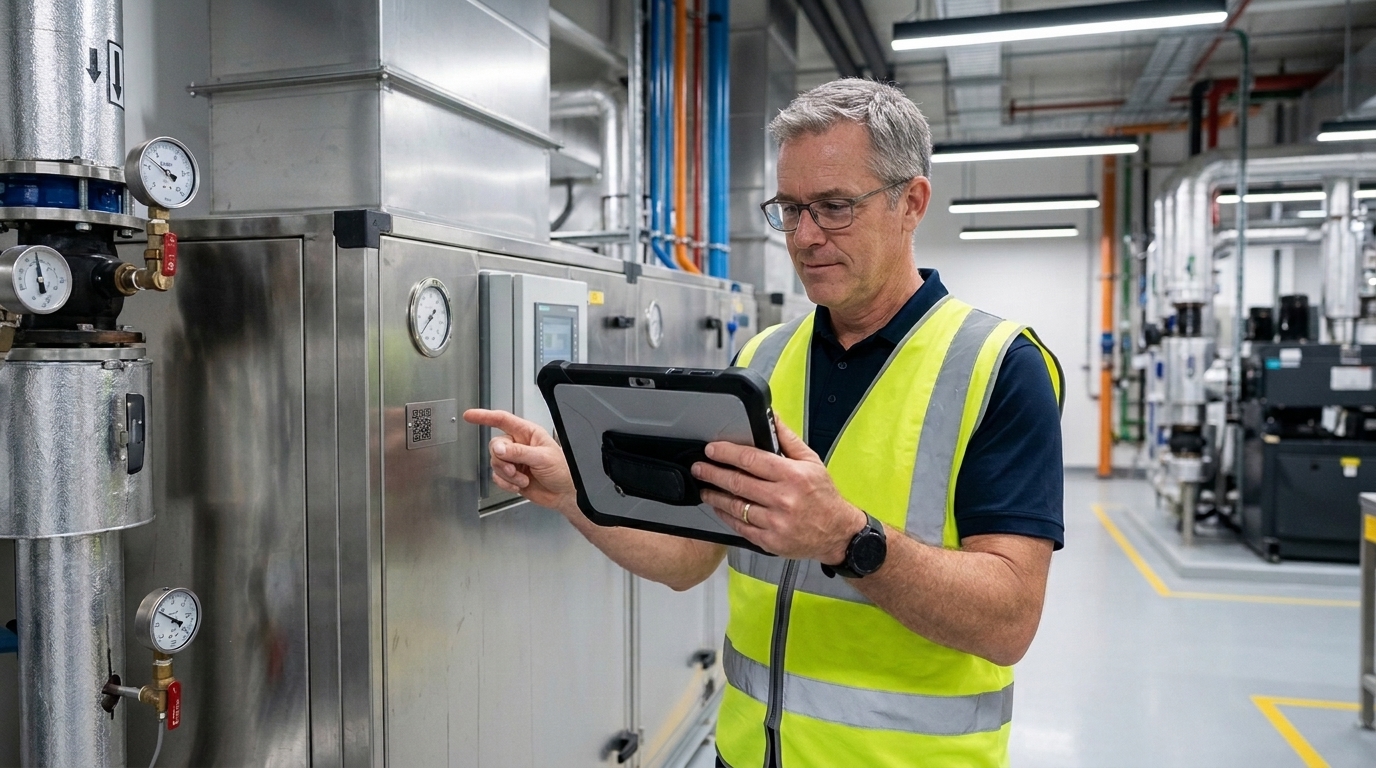
- Instant Engineering Knowledge Retrieval: The technician points their tablet camera at an AHU nameplate or complex electrical relay; the copilot instantly pulls exact wiring schematics, torque tolerances, and diagnostic fault trees from digitized technical libraries.
- First-Time Fix Acceleration: Ensures the technician arrives at the plant room with the correct gaskets, tools, and calibration equipment on trip one, lifting first-time fix rates by over 20%.
5. Reinforcement Learning: Continuous Energy Optimization
Heating, ventilation, and air conditioning (HVAC) systems account for up to 60% of total electrical energy spend in Middle Eastern commercial buildings. Static BMS setpoints cannot adapt to rapid changes in ambient wet-bulb temperature, building thermal inertia, and dynamic occupant density.
- Dynamic Setpoint Modulation: Autonomous algorithms continuously modulate chilled-water supply temperatures, condenser water loops, and variable frequency drive (VFD) speeds every 5 minutes.
- Peak Shaving: Pre-cools building thermal mass during off-peak utility tariffs, cutting peak electrical demand charges without compromising tenant comfort.
6. Generative AI: Precision RFP Costing & Bidding Automation
Pre-contract commercial leverage dictates the entire profitability lifecycle of a 5-year FM contract. Generative AI tools ingest massive tender documentation to automate:
- RFP Ingestion & Scope Parsing: Extracts technical SLA penalties, required staffing ratios, and asset registers across thousands of pages of tender documents in minutes.
- Compliance Matrix Generation: Eliminates human oversight errors by cross-checking proposal drafts against mandatory client qualification clauses.
- Speed to Proposal: Accelerates bid turnaround velocity by 65%, enabling bid teams to submit higher-quality bids with validated margin models.
Key Takeaways for FM Leadership
- AI is not an all-or-nothing proposition; deploy the specific AI tool that maps directly to your largest P&L cost center.
- Always implement strict Human-in-the-Loop approval gates for safety-critical and financial execution triggers.
- Equip your frontline workforce with voice and vision tools; when you solve data collection for the technician, you solve reporting for the board.
👉 Next Step: Chapter 3: KSA & GCC Case Studies — Real-World Performance Audits